Story preview
Use clues and questions to return each item to its owner
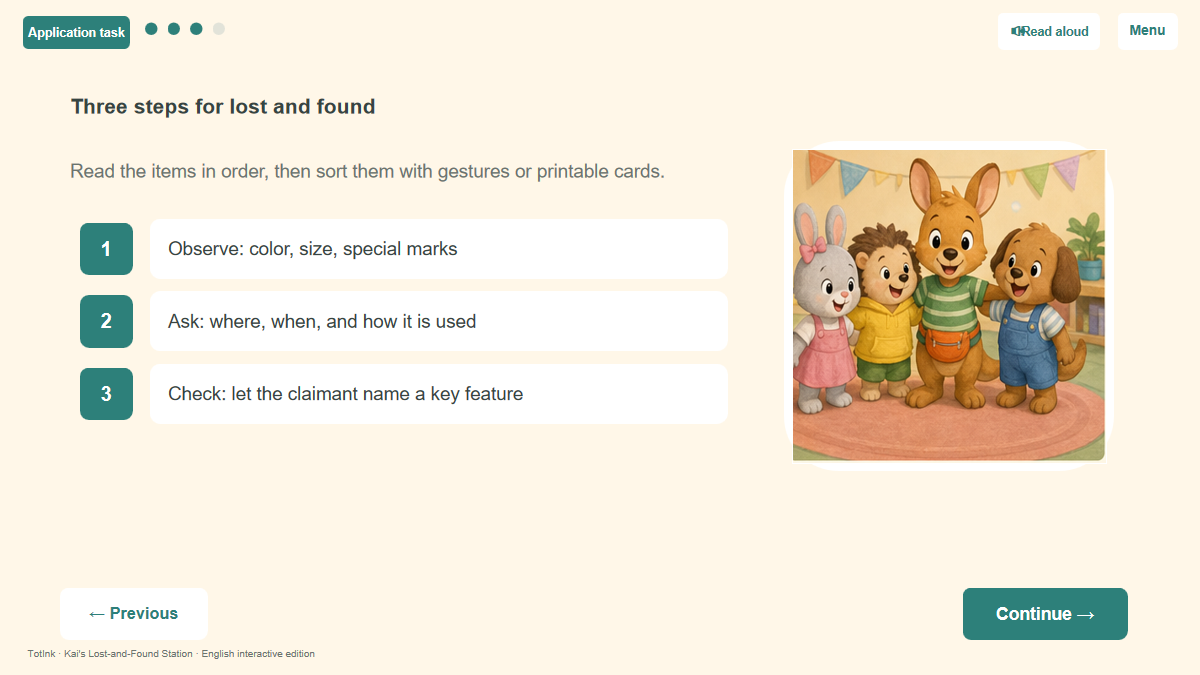
Use clues and questions to return each item to its owner. Includes a 30-slide interactive PPTX, three branching challenges, instant feedback, gentle English narration, a teacher guide, and four printable pages.
A picture book resource for preschool, kindergarten and family reading. Use it for shared reading, story discussion, vocabulary practice and printable extension activities.
Preview the actual story text here before deciding whether to download it.
Use clues and questions to return each item to its owner
Kai's Lost-and-Found Station Use clues and questions to return each item to its owner
Ages 4–6
Social Skills and Clue-Based Reasoning Learning goal Describe an item's features, ask checking questions without revealing the answer, and understand that returning belongings is a responsibility. Big question How can a blue-striped glove, a yellow bottle, and a teddy bear find their true owners? Repeated refrain Look for clues, then ask with care, and lost things can go home. Warm-up Hide a familiar object in a bag. Describe only its color, shape, and use while classmates guess. ============================================================ Core scene 01 | Three Things in a Basket Kai finds a blue-striped glove, yellow bottle, and brown teddy in the classroom. He gives them to the teacher instead of taking them. Core scene 02 | A Lost-and-Found Table Kai and the teacher set out a basket and agree to record where each item was found and any special features. Core scene 03 | Look Before You Guess Inside the glove is a soft star. The bottle strap has two blue lines. Kai remembers each clue. Core scene 04 | What Did Rabbit Lose? Rabbit says a glove went missing in the block area and names the star inside. The clues match. Core scene 05 | The Bottle's Owner Hedgehog says it was lost on the playground and describes the blue lines. Kai asks about the cap before returning it. Core scene 06 | The Teddy Cannot Talk Kai does not reveal the answer. He asks, “What is special about your toy?” Core scene 07 | Dog Remembers the Patch Dog says the teddy has a round patch on its left foot. Kai checks and finds the same mark. Core scene 08 | An Item Children Should Not Claim Someone brings unfamiliar keys. Kai gives them to the teacher for safekeeping and does not try them. Core scene 09 | A Picture Record Card Kai draws the place, time, and features. Next time, everyone finds a missing scarf more quickly. Core scene 10 | Everything Goes Home The basket is empty and the friends feel relieved. They repeat the lost-and-found refrain together. ============================================================
You find a bottle that is not yours. What should you do first? A. Take it home B. Give it to a teacher or lost-and-found area (correct) C. Hide it in a cupboard
A responsible adult can protect the item and help its real owner find it.
Which question best checks who owns the teddy? A. Do you want this teddy? B. Where does your teddy have a special patch? (correct) C. Is your teddy brown?
Having the claimant name a key feature is more reliable than a simple yes-or-no answer.
What should Kai do with unfamiliar keys or a valuable item? A. Try to find what it opens B. Give it to an adult immediately (correct) C. Pass it around the class
An adult should keep unfamiliar keys and valuables safe. Children should not test or share them. Extension activity Create a one-week class “lost-item observer” job. Use picture cards to record where an item was found and what it looks like. Teacher note Do not have children call out an owner's name. Practice open descriptions and checking. Give valuable or unfamiliar items directly to an adult.
Use the story to build comprehension, language and conversation around the book’s topic.
Read the story aloud, pause for predictions and invite children to connect the events with their own experience.
Choose one question from the final slide, let children respond by speaking, drawing or acting, and revisit the key idea together.
The cards below show the files that are actually available for this book.