Courseware preview
A preschool investigation from chewing to absorption
A preschool investigation from chewing to absorption. Includes a 30-slide interactive PPTX, three branching challenges, instant feedback, gentle English narration, a teacher guide, and four printable pages.
This courseware is designed for preschool and kindergarten classroom use.
Use the slides for guided teaching, then check understanding with discussion or the supplied worksheet.
Preview the slides before class, choose the pages that match your group and prepare any real objects or printables you want children to use.
Introduce the topic, teach with the visual slides, invite children to respond, then use the worksheet or a short practical activity to review.
Preview the actual lesson content here before deciding whether to download it.
A preschool investigation from chewing to absorption
Food's Journey Through the Body A preschool investigation from chewing to absorption
Ages 4–7
Body Science and Healthy Habits Learning goal Describe the simplified path through mouth, esophagus, stomach, and intestines, and understand slow chewing, balanced food, water, and movement. Big question After you bite an apple, where does it go and how does it become energy your body can use? Repeated refrain Chew it well and swallow slow; the body factory helps it go. Warm-up Seal soft banana and cracker crumbs in a bag and gently squeeze to model mixing. Do not eat the experiment. ============================================================
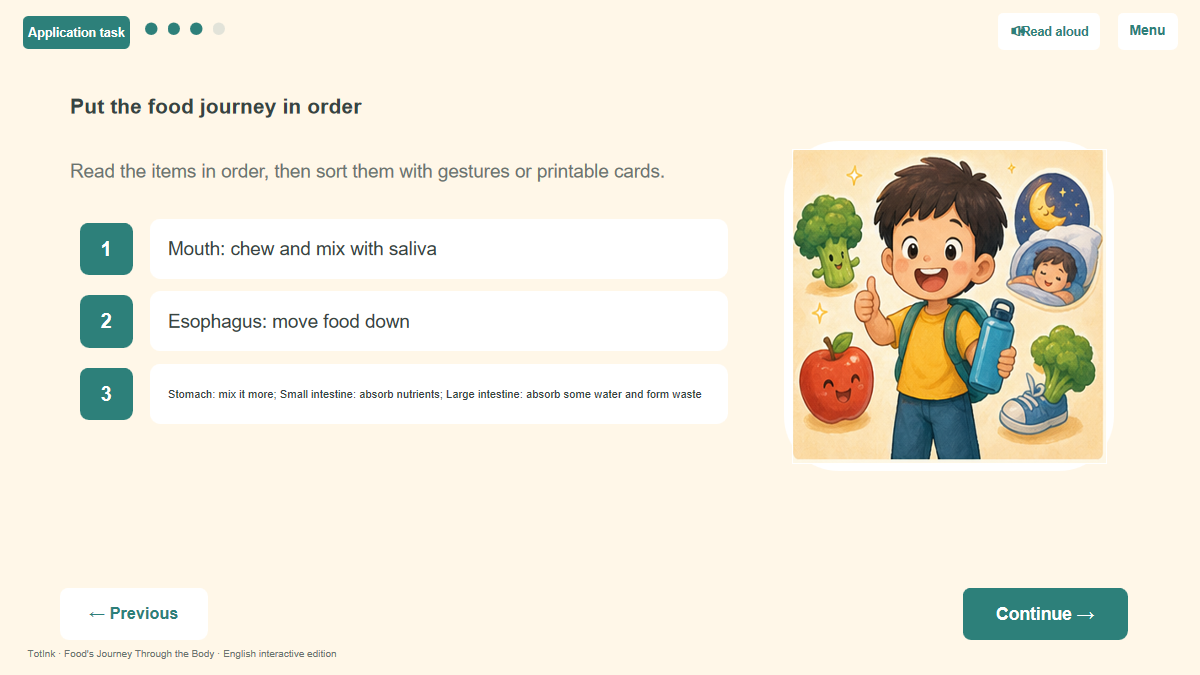
The Mouth Teeth cut and grind food, the tongue mixes it, and saliva makes it wetter and easier to swallow. Core scene 02 | Why Chewing Matters Chewing makes pieces smaller. Sitting and eating slowly also lowers the risk of choking.
The Esophagus After swallowing, food moves down the esophagus. Do not run or laugh with food in your mouth.
The Stomach The stretchy stomach uses muscle movement and digestive juices to keep processing food. Core scene 05 | The Stomach Is Not a Storage Box Eating too quickly or too much can feel uncomfortable. We can notice hunger and fullness signals.
The Small Intestine Its long inner surface absorbs many nutrients and sends them into the body for growth and activity. Core scene 07 | Nutrients Have Different Jobs Grains, fruit and vegetables, protein foods, and dairy provide different nutrients. Variety works best.
The Large Intestine It absorbs some more water and organizes what the body does not need into waste. Core scene 09 | Water and Movement Help Enough water, regular movement, and a steady routine help the digestive system work well. Core scene 10 | The Whole Journey Many organs work together to process one bite of food. Repeat the body-factory refrain. ============================================================
Where is the first stop in food's journey? A. The stomach B. The mouth (correct) C. The small intestine
Food is first chewed, moved by the tongue, and mixed with saliva in the mouth.
Which habit helps you swallow safely? A. Eat while running B. Sit down and chew slowly (correct) C. Laugh with food in your mouth
Sitting and chewing and swallowing slowly make eating safer.
What is one important job of the small intestine? A. Carry air into the lungs B. Absorb many nutrients (correct) C. Harden the teeth
The small intestine absorbs many digested nutrients into the body. Extension activity Make a “body factory passport.” Add a shape stamp at every stop and name that stop's main job. Teacher note Use simplified but accurate science; organs do not literally think. Respect family and medical guidance for children with feeding or digestive conditions.
The cards below show the files that are actually available for this lesson.